

Where to stay in Sarajevo: Ilidža or the Old Town?
7 min read · River Walk Sarajevo
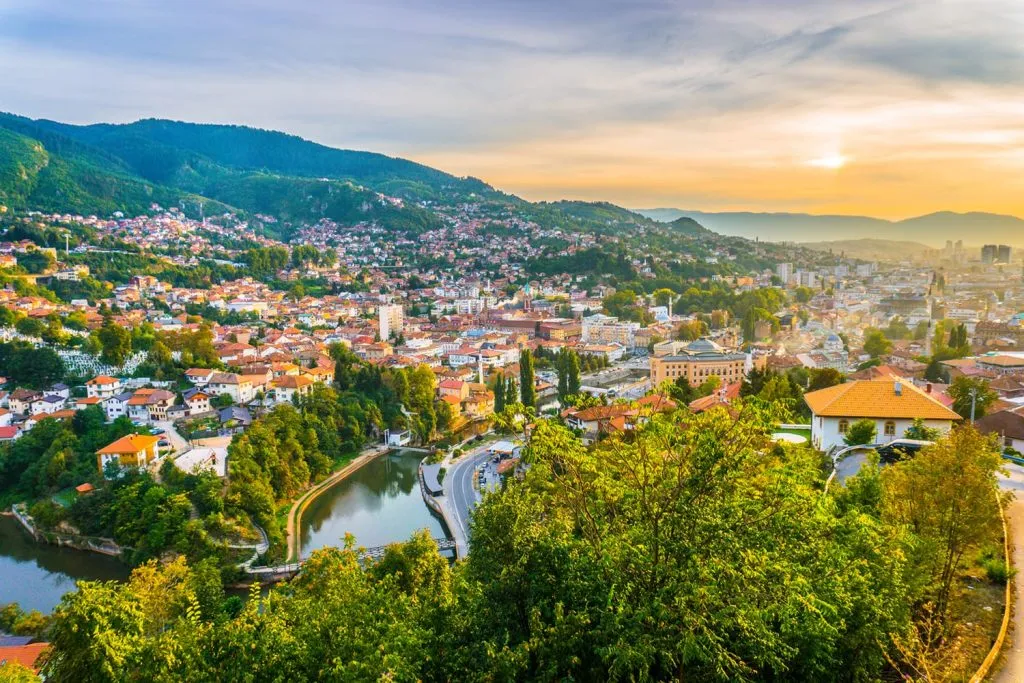
Every week someone asks us the same question at reception: should we have booked in the Old Town instead? Sometimes the honest answer is yes. Sarajevo is a long, narrow city squeezed into a valley, and where you sleep changes your trip more than in most European capitals. Here is the comparison we give friends, with the parts hotels usually leave out.
Short answer: for a two-night city break, stay in or around Baščaršija and walk everywhere. For families, stays of four nights or more, remote work, or an early flight, Ilidža is the more comfortable base. River Walk Sarajevo at Butmirska cesta 16 in Ilidža has riverside serviced apartments of 46–80 m² from €69 per night, a five-minute drive from Sarajevo Airport, with the Old Town about 35 minutes away on tram line 3.
Baščaršija and the Old Town: the postcard, with footnotes
Baščaršija is the reason most people come. The Ottoman bazaar, Sebilj fountain, ćevapi smoke drifting between coppersmith shops, the call to prayer overlapping with cathedral bells — it is genuinely one of the best old towns in the Balkans, and it is not a museum. People actually live and work there.
If you have two nights in Sarajevo, stay here. Full stop. You will walk out of your door into everything: Gazi Husrev-beg Mosque, the City Hall (Vijećnica), Kazandžiluk street, the Latin Bridge. Evenings in the čaršija are the point of the trip, and no tram ride compares to stumbling home from a čevabdžinica in eight minutes.
Now the footnotes. Rooms in the old core are mostly small — converted Austro-Hungarian and Ottoman buildings were not designed around luggage. Many guesthouses have steep stairs and no elevator; check before you book if that matters. Nightlife noise carries until midnight or later on weekends, and delivery vans rattle the cobbles from about 6 in the morning. Parking is the real pain: street parking barely exists, garages charge around 20–30 KM per day, and your navigation app will cheerfully send you into a pedestrian zone. And in summer, small rooms under old roofs get hot — air conditioning is common now but not universal.
Marijin Dvor and the center: business Sarajevo
West of the old town, around Marijin Dvor, Sarajevo turns into a normal European city: the parliament, the museums, the US Embassy, shopping centers, corporate hotels. If you are here for meetings, a conference, or the National Museum and Historical Museum, this is the practical choice. Trams run constantly along the main artery.
What it lacks is charm. You are in traffic, the architecture is a mix of Austro-Hungarian, socialist and glass, and in the evening the area goes quiet in the wrong way. It works as a base; it is rarely anyone's favorite part of the trip.
Ilidža: where Sarajevo goes on Sunday
Ilidža sits at the western end of the valley, where the tram line ends and the plane trees begin. This is where Sarajevans themselves go to breathe: the thermal spa, the Velika Aleja avenue, the walk to Vrelo Bosne springs, riverside paths along the Željeznica. It is green, flat, and quiet at night in a way the old town simply cannot be.
The practical advantages stack up. Apartments here are large by Sarajevo standards — at River Walk they run 46 to 80 m², which is two or three times a typical old-town room, at prices from €69 a night. Parking is free or easy almost everywhere. The airport is a five-minute drive, not a forty-minute crawl through the valley. Terme Ilidža, the thermal spa complex, is a six-minute walk from our door. And tram line 3 leaves from the Ilidža terminus — you board at the start of the line, get a seat, and step off at Baščaršija about 35 minutes later. Trams run from early morning until around 11 at night.
Downsides, because there are some: you are not going to wander back from a late dinner in the čaršija on foot. After the trams stop, a taxi to Ilidža costs roughly 20–25 KM. The restaurant scene here is solid but local — good grilled meat, good fish, no fine dining. And in July and August Ilidža fills with summer visitors, so the Velika Aleja on a Sunday afternoon is a promenade, not a solitude.
So who should stay where?
- First visit, 1–3 nights, no car: Old Town. The evenings alone justify the small room.
- Business trip: Marijin Dvor or the center.
- Families with children: Ilidža. Space to spread out, flat riverside paths for strollers and scooters, the springs and the horse carriages at Vrelo Bosne, and no midnight noise.
- Stays of 4+ nights: Ilidža. A full kitchen, a washing machine and a table you can actually eat at start to matter around night four.
- Remote workers: Ilidža. Desk space, quiet, fast wifi, and a morning run along the river instead of a lap around a parking garage.
- Early flights: Ilidža, without question. Five minutes to the airport versus 30–40 from the old town, longer if it snows.
- Summer guests from the Gulf: Ilidža has been the preferred summer base for Gulf families for years — halal food is everywhere in Sarajevo, but the space, greenery and cooler evenings by the water are what people come back for.
- Anyone with a car: Ilidža. Old-town parking will tax both your wallet and your marriage.
The honest bottom line
If this is a quick city break, book the Old Town and accept the small room as part of the experience. If Sarajevo is your base for a week — day trips to the mountains, work calls in the morning, kids who need a park — the math flips, and Ilidža wins on space, sleep, parking and airport logistics. We run River Walk on that second bet, and our reviews (8.6 on Booking.com from more than 900 stays, 9.1 for location) suggest the people who choose Ilidža for the right reasons rarely regret it. Choose for your trip, not for the postcard.