

Ilidža: Sarajevo's green side
6 min read · River Walk Sarajevo
Ask a Sarajevan where they go on a Sunday and the answer is usually Ilidža. The city's western district is where the valley opens up, the Bosna river rises out of the mountain, and the air is a degree or two cooler than the center. It has been a resort for longer than Sarajevo has had trams — and it still works best the old way: on foot, slowly, with lunch in the middle.
The springs that built the place
Ilidža's thermal springs were used by the Romans, but the town you see took shape in the 1890s, when the Austro-Hungarian administration built a full spa resort here — grand hotels around a park, a racetrack, and Bosnia's first railway spur to bring Vienna society in comfortably. The name itself comes from an old word for a healing bath. Some of those yellow-and-cream hotel buildings still stand around the central park, and the tradition survives at Terme Ilidža, a modern thermal complex with indoor and outdoor pools fed by the same warm sulfurous water. Entry is reasonably priced by spa standards, it gets busy with local families on weekends, and it is honestly more municipal-pool-with-history than luxury spa — go for the soak, not the marble. If you are staying at River Walk it is a six-minute walk.
Velika Aleja: the avenue
The centerpiece of Ilidža is the Velika Aleja, a dead-straight 3.5 km avenue lined with plane trees planted in the 1890s, running from the spa quarter to the Vrelo Bosne springs. It is closed to cars. You walk it in about 45 minutes, cycle it in 15, or do it the classic way: in a horse-drawn carriage (fijaker). The carriages wait at the Ilidža end; expect to pay around 20–30 KM for the ride and agree the price before you climb in. From the riverside at Butmirska cesta, the start of the Aleja is about 850 meters — close enough that you will end up walking it more than once.
Vrelo Bosne: where the river starts
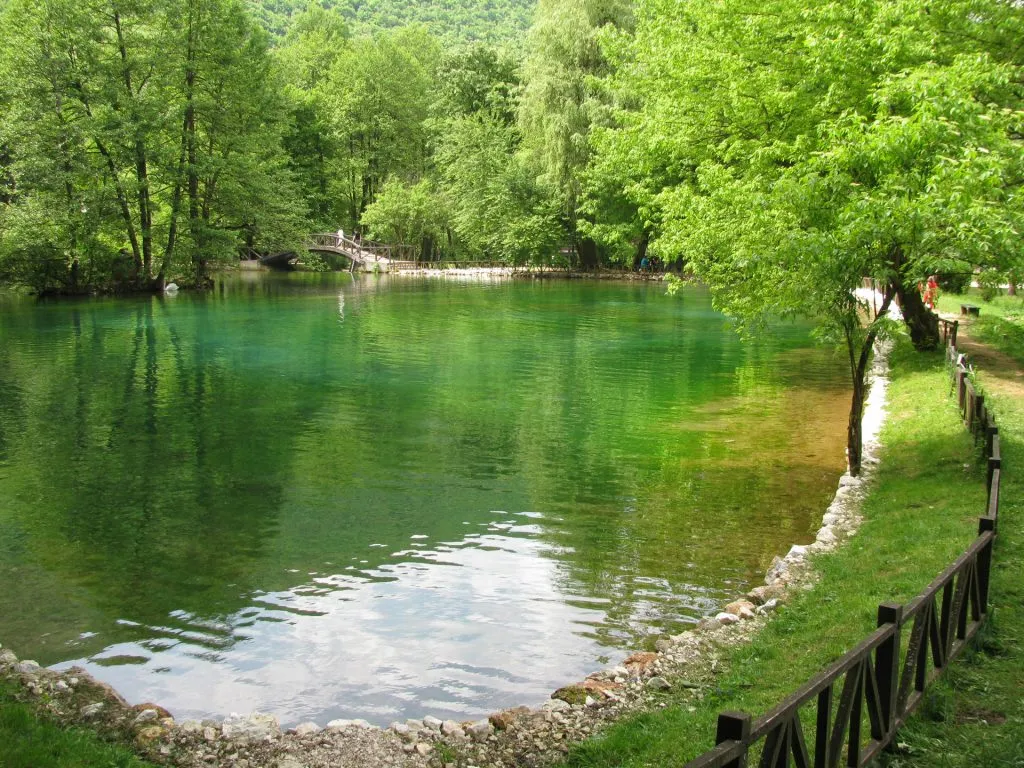
At the far end of the Aleja, the Bosna river simply appears — dozens of springs pouring out of the base of Mount Igman into a park of channels, wooden footbridges, islands and swans. The water is drinkable, glass-clear and cold enough to hurt. Entrance costs around 2–4 KM. Come on a weekday morning if you can; on summer Sundays half of Sarajevo has the same idea. There is a park restaurant, but the smarter move is to walk back and eat properly in Ilidža. In autumn, when the plane trees turn, the Aleja is arguably the best free sight in the whole city.
The Roman bridge and the Željeznica
Ten minutes' walk from the spa quarter, the Roman Bridge crosses the Bosna — Ottoman-era stonework, built with reused Roman material, hence the name. It is quiet, unfenced and usually empty, which is exactly its charm. The other river, the Željeznica, runs along Butmirska cesta with a flat gravel-and-asphalt path on the bank — this is where locals run, fish and walk dogs, and where you will end up with your morning coffee if you stay riverside. Herons are a regular sight; kingfishers if you are lucky.
Eating in Ilidža
Ilidža eats like a Bosnian town, not like a tourist zone, and that is a compliment. The staples are done properly: ćevapi in fresh somun bread with raw onion and kajmak, begova čorba, grilled trout from local farms, and pod sačem dishes (meat and potatoes cooked under an iron bell) if you order ahead. Restaurants cluster around the central park, the Aleja entrance and along the rivers. A generous meal for two runs 30–50 KM at a local grill. Nearly everything is halal by default. What you will not find is fine dining — for that, go into the city.
The mountains at the door
Ilidža sits directly under Igman and Bjelašnica, the 1984 Winter Olympics mountains, and this is the district's quiet superpower: you can be at 1,200+ meters in 30–40 minutes by car. In winter that means skiing on Bjelašnica with rental gear and day passes far cheaper than the Alps. In summer, hiking on Igman's meadows, the highland villages behind Bjelašnica (Lukomir, the highest in the country, is a spectacular half-day trip), and mountain roads that beg for a rental car. The War Tunnel Museum — the hand-dug tunnel under the airport runway that kept the city alive during the 1992–95 siege — is 3.2 km away and should not be skipped; it explains more about Sarajevo in an hour than any walking tour.
Practical notes
- Tram line 3 links Ilidža with Baščaršija in about 35 minutes; the terminus is the start of the line, so you get a seat.
- Carriages and market stalls are cash-only. Keep small KM notes.
- Vrelo Bosne entrance: roughly 2–4 KM. Weekday mornings are quietest.
- The Aleja and riverside paths are flat — ideal with strollers, bikes or unreliable knees.
- July–August evenings by the water are noticeably cooler than the city center; bring a layer.
- Winter fog is common in the mornings and usually lifts by noon — plan mountains for the afternoon.
Ilidža will not give you the Ottoman skyline or the museum density of the center. What it offers is the version of Sarajevo that Sarajevans actually use: water, trees, long flat walks and unhurried lunches. Base yourself here — River Walk sits right on the Željeznica, 850 meters from the Aleja — and you get both cities: the loud one at the end of the tram line, and the quiet one outside your window.